
A rural software engineer generated over $1.2 million in revenue using PHP by combining offline documentation, batch-downloading protocols, asynchronous client communication, and high-value niche web development—proving that constant internet access is not required to build a multi-million dollar tech career.
The Rural PHP Developer Who Made $1.2M While Living Without Internet
Most people believe that to make money as a software developer, you need ultra-fast fiber internet, a high-tech office, and nonstop connectivity.
This is the story of how one developer completely broke that rule. Living in a remote village with zero home internet access, he built a global freelancing business and custom software development agency that earned $1.2 million over seven years.
Instead of seeing his location as a weakness, he built a system that turned offline work into his greatest strength. Here is the exact breakdown of how he did it, the tech stack he used, and how you can apply these same principles to achieve real results in your own career.
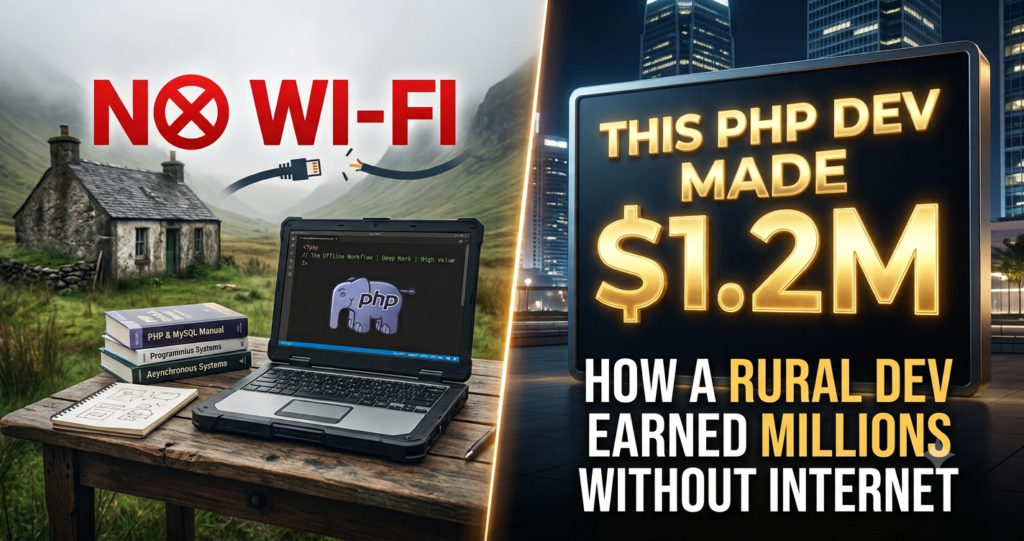
1. The Impossible Setup: Life in the Offline Zone
Imagine sitting down at your desk to code, but you cannot open Google. You cannot ask ChatGPT for help, you cannot search Stack Overflow when an error pops up, and you cannot watch a YouTube tutorial to fix a bug.
For this developer, that was daily reality. His small mountain town had no internet infrastructure. The nearest town with a stable mobile data signal was a 45-minute drive away.
The Daily Routine
To survive, he had to divide his daily work into two distinct phases:
- The Connected Hour (The Data Sprint): Once a day, he would drive to a local roadside cafe with mobile coverage. In 60 minutes, he downloaded client emails, pulled code repositories, and downloaded full documentation libraries.
- The Offline Block (Deep Work): For the remaining 8 to 10 hours of the day, he worked at his quiet home desk with zero notifications, zero social media distractions, and total focus.
While most developers lose hours every day scrolling through social media or context-switching between chat apps, his forced isolation gave him deep focus.
2. The Offline Blueprint: How to Code Without Wi-Fi
How do you debug complex software when you can’t search for solutions online? You build an offline technical system.
+-------------------------------------------------------------------+
|                     THE OFFLINE WORKFLOW SYSTEM                   |
+-------------------------------------------------------------------+
|                                                                   |
|   1. Local Documentation  ==>  Dash / Zeal offline API docs       |
|   2. Local Test Engine    ==>  Docker + Local SQLite/MySQL        |
|   3. Code Backup Protocol ==>  Local Git commits throughout day   |
|   4. Daily Sync Sprint    ==>  Push code & email during cafe trip |
|                                                                   |
+-------------------------------------------------------------------+
Essential Offline Tools
To work smoothly without a connection, he set up a complete local development ecosystem:
- Zeal / Dash: Offline documentation browser tools that download complete manuals for PHP, JavaScript, MySQL, and HTML directly to a laptop.
- Local Package Archives: Before starting any project, he downloaded all necessary composer packages and dependencies during his daily cafe trip.
- Local Server Environments: He ran lightweight local servers using Docker and XAMPP, allowing him to test complete web applications without sending a single byte of data to the web.
The Mental Shift
When you know you cannot search Google for a quick solution, you read code more carefully. You test your logic step-by-step. His error rates dropped significantly because he spent more time planning architecture on paper before typing a single line of code.
3. The $1.2 Million Tech Stack (Why PHP?)
With dozens of modern programming languages available, why choose PHP?
The choice was completely practical. PHP is one of the most stable, reliable, and widely supported languages on the planet.
| Feature | Modern JS Frameworks | PHP & MySQL Stack |
| Setup Complexity | High (Heavy dependency trees) | Low (Single runtime environment) |
| Documentation Size | Changes constantly | Extremely stable & lightweight |
| Market Demand | High, but fast-shifting trends | Powers 75%+ of the web |
| Offline Reliability | Frequent broken packages | Works seamlessly offline |
High-Value Niche Focus
Instead of building basic websites, he focused on custom business applications using custom PHP and Laravel:
- Custom E-commerce Engines: Building tailored checkout systems for niche businesses.
- Database Optimization: Fixing slow, bloated databases for established companies.
- API Integrations: Connecting old internal company software with modern payment gateways.
Because he targeted business-critical problems rather than basic landing pages, he could easily charge $75 to $150 per hour, even while living in an area with cheap living expenses.
4. Managing Clients Without Constant Messaging
One of the biggest obstacles was client communication. Modern clients often expect real-time answers on Slack or Microsoft Teams.
To fix this, he turned his lack of internet into a professional selling point.
The Asynchronous Communication Agreement
When onboarding new clients, he set clear boundaries upfront:
“I operate on a deep-work schedule. I do not answer messages instantly. Instead, I deliver comprehensive progress updates once every 24 hours along with fully tested code.”
Why Clients Loved It
- Higher Code Quality: Fewer interruptions meant fewer bugs and faster overall project delivery.
- Clear Daily Logs: Every evening, clients received a clear bulleted list of what was completed, what was blocked, and what was coming next.
- Zero Drama: Expectations were clear from day one, so clients never felt ignored.
5. Income Growth: From $200 First Project to $1.2 Million
Success did not happen overnight. The financial journey spanned seven years of steady growth:
- Year 1 ($18,000): Small local freelance jobs, basic PHP bug fixes, and WordPress customizations.
- Year 2-3 ($120,000 total): Transitioned to long-term contract work with international clients via job platforms.
- Year 4-5 ($450,000 total): Specialized in custom Laravel web apps and enterprise database optimization.
- Year 6-7 ($612,000 total): Built a small team, packaged repeatable software solutions, and managed high-retainer enterprise clients.
By keeping his overhead low and living costs minimal in a rural zone, he saved and invested over 60% of his gross earnings.
6. How You Can Apply This Strategy Today
You do not need to move to a remote village without internet to profit from this model. You can apply these exact principles to increase your productivity and earning power right now.
Actionable Recommendations
- Practice “Offline Focus Blocks”: Turn off your Wi-Fi for 3 hours every day. Force yourself to build features and debug code using local documentation rather than searching for instant answers.
- Master Asynchronous Work: Train your clients and team members to communicate via detailed daily summaries instead of pinging you every ten minutes on chat apps.
- Pick a Stable Core Tech Stack: Do not chase every shiny new JavaScript framework. Master proven technologies like PHP, Python, or SQL that have reliable ecosystems and deep commercial demand.
- Solve High-Value Business Problems: Shift your services from basic site creation to revenue-generating features like custom checkout flows, inventory systems, or backend integrations.
- Build an Offline Emergency Kit: Install offline documentation tools like Zeal or Dash on your computer today. You will be amazed at how much faster you learn when you read complete manuals instead of fragmented forum posts.
Also Read: The 2026 PHP Developer Salary Guide (Real Numbers)
Conclusion
The story of the $1.2 million rural PHP developer proves an important point: Your environment does not dictate your success—your focus and system do.
While many developers waste time distracted by noisy group chats and endless internet feeds, forced offline work creates deep, concentrated focus. By mastering a stable language, setting clear communication boundaries, and delivering clean, well-tested code, you can build a highly profitable software career from anywhere in the world.

